The Short Answer
Scotiabank Gold Amex comes out ahead in the three one-cent-per-point examples below. Its lower annual fee, selected-grocer multiplier and lack of foreign transaction markup make a measurable difference. Amex Cobalt can become more attractive when the value you actually get from Membership Rewards is higher.
The useful comparison is your annual rewards value after fees, using the stores and redemptions you will actually choose. A larger points total alone does not settle it.
Details checked November 14, 2026. We compare ongoing value, excluding welcome bonuses and bank-account fee rebates. Terms can change; check the issuer disclosures before applying.
Amex Cobalt vs Scotia Gold at a Glance
| Feature | American Express Cobalt | Scotiabank Gold American Express |
|---|---|---|
| Regular primary-card fee | $15.99 monthly; $191.88 yearly equivalent | $120 annually |
| Eligible Canadian groceries and dining | 5 points per $1 | 5 points per $1; 6 at selected participating grocers |
| Eligible gas and transit in Canada | 2 points per $1 | 3 points per $1 |
| Select streaming | 3 points per $1 | 3 points per $1 |
| Other eligible spending | 1 point per $1 | 1 point per $1 |
| Foreign transaction markup | 2.5% | None; network exchange rate still applies |
Cobalt's 5-point food category is capped at $2,500 per calendar month, then earns one point per dollar. Its fee is billed annually at $191.88 in Quebec. See Cobalt product terms and earning rules.
Scotia's accelerated categories share a $50,000 calendar-year spending cap, then earn one point per dollar. Accelerated rates apply to eligible Canadian-dollar purchases; foreign-currency purchases earn one point per dollar. Its five-point categories also include eligible entertainment. See Scotiabank Gold terms and participating stores.
What Are the Points Worth in This Comparison?
We use one cent per point for both programs, tied to specific redemption options:
- Membership Rewards: 1,000 points for $10 in eligible statement credits through Amex's rewards program.
- Scene+: 100 points for $1 through eligible Scene+ Travel redemptions.
This does not mean every redemption in either program has the same value. Nor does it make Scene+ travel redemptions identical to unrestricted cash. Use a value you can realistically redeem, and verify the current redemption conditions.
Our formula is: annual eligible points × dollars per point − regular card fee − foreign transaction markup. We assume purchases are paid in full, no returns, no optional coverage and no supplementary cards. We assign no dollar value to insurance or other benefits.
Three Spending Profiles: Annual Net Value
The first two profiles spend $1,500 monthly. The third adds $3,000 of annual foreign-currency spending, expressed as the Canadian-dollar equivalent before any issuer markup.
| Spending category | Monthly amount |
|---|---|
| Groceries | $600 |
| Dining | $300 |
| Gas or transit | $150 |
| Eligible streaming | $50 |
| Other purchases | $400 |
| Total domestic spending | $1,500 |
All transactions are assumed to qualify for their stated category and be accepted by the merchant. Spending is spread evenly through the year and stays below both cards' applicable caps.
| Profile | Cobalt annual points | Scotia Gold annual points | Cobalt net annual value | Scotia Gold net annual value |
|---|---|---|---|---|
| 1. Grocer earns 5 points with both cards | 64,200 | 66,000 | $450.12 | $540.00 |
| 2. Grocer qualifies for Scotia's 6-point rate | 64,200 | 73,200 | $450.12 | $612.00 |
| 3. Profile 1 plus $3,000 foreign-currency spending | 67,200 | 69,000 | $405.12 | $570.00 |
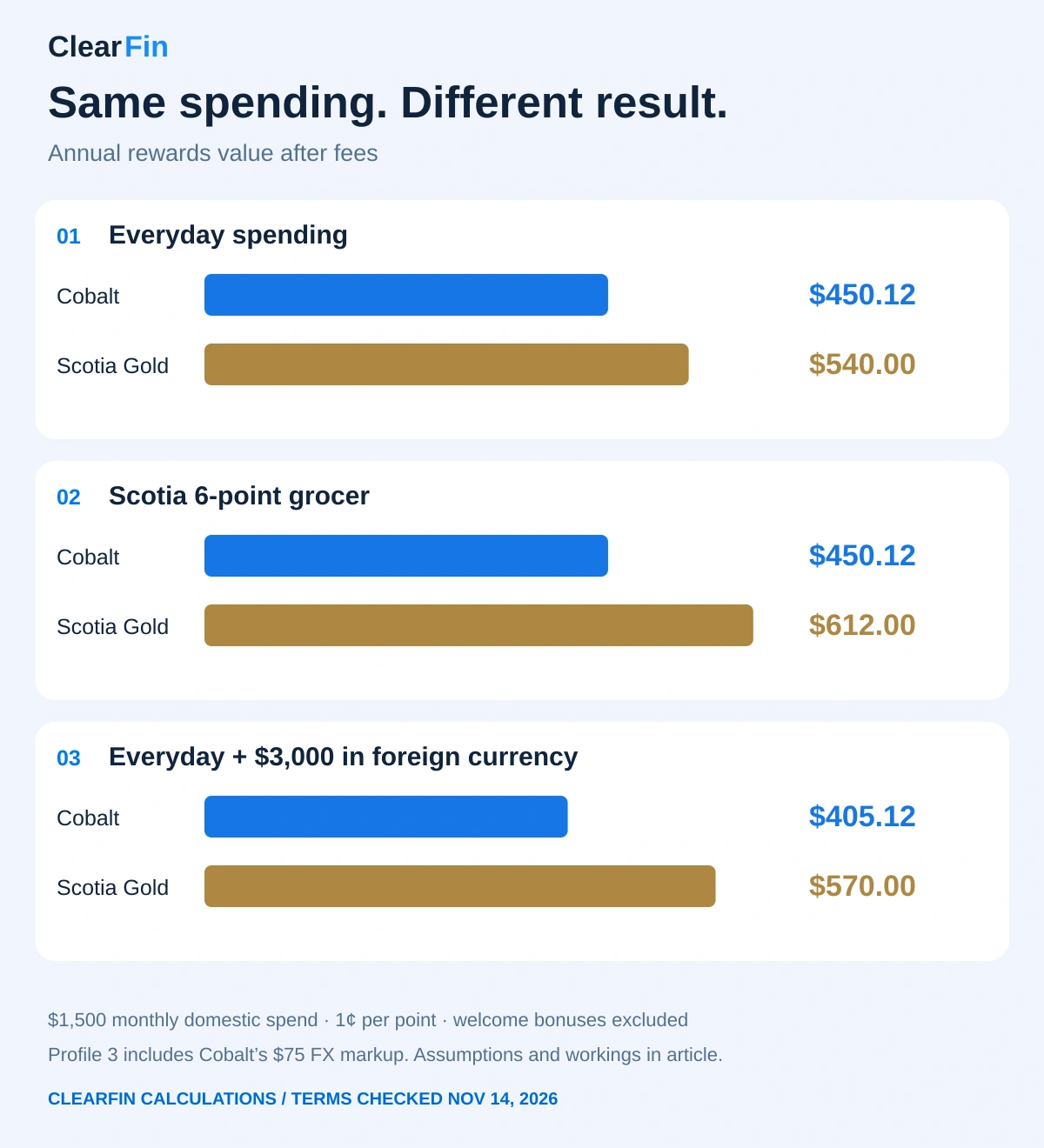
These are ClearFin's illustrative calculations, not issuer earnings promises.
Profile 1: Everyday Spending at a Five-Point Grocer
Cobalt earns 5,350 points per month: 4,500 from food, 300 from gas or transit, 150 from streaming and 400 from other spending. That is $642 annually at our assumed redemption value, less its $191.88 fee.
Scotia earns 5,500 points per month because gas or transit earns an extra point per dollar. Its $660 annual rewards value minus $120 leaves $540. The $89.88 difference combines the fee difference with the additional category earnings.
Profile 2: A Participating Six-Point Grocery Store
Moving the same $600 monthly grocery spend to a qualifying six-point Scotia grocer adds 7,200 Scene+ points annually compared with Profile 1. No extra spending is required in this illustration; only the eligible store changes.
That raises the Scotia result to $612, or $161.88 above Cobalt at one cent per point. Check your actual store and card acceptance before treating the selected-grocer rate as available.
Profile 3: An Additional $3,000 in Foreign Currency
Both cards earn 3,000 extra points under this example's foreign-spending assumptions. At one cent each, that adds $30 to either rewards total. Cobalt's 2.5% markup costs $75, while Scotia has no issuer foreign transaction markup.
The result is $405.12 for Cobalt and $570 for Scotia. “No foreign transaction markup” does not mean the exchange rate is free or fixed; currency conversion still occurs.
When Could Cobalt Come Out Ahead?
A different realized redemption value can change the result. In Profile 1, Cobalt needs a value of roughly 1.14 cents per point to match Scotia's $540 net result, holding Scotia at one cent per point:
($540 + $191.88) ÷ 64,200 points = $0.01140 per point.
At an assumed 1.5 cents per Cobalt point, the same 64,200 points would be worth $963, leaving $771.12 after its fee. This is a sensitivity calculation, not a promised redemption or a claim that every user can obtain that value.
When evaluating an alternative redemption, use what you would otherwise pay and subtract unavoidable extra costs. An attractive theoretical valuation is not useful if the redemption does not fit your plans.
Monthly Caps and Store Acceptance Can Change the Answer
An annual average can hide a concentrated spending month. For example, $3,000 in Cobalt's eligible food category in one calendar month earns 12,500 points on the first $2,500 and 500 points on the remaining $500: 13,000 points, not 15,000. Unused capacity from another month does not raise that monthly cap.
Scotia's shared annual cap creates a different constraint: several accelerated categories draw from the same allowance. Read our guide to credit card earn-rate caps before extrapolating a top multiplier across all spending.
Neither card solves an American Express acceptance gap. If your usual shop does not accept Amex, remove that spending from the projected earnings and consider what a backup card earns there.
Which Card Fits Your Routine?
Choose based on the factors you can verify:
- Start with Scotia Gold if its selected grocers match your routine, your intended Scene+ redemption works at the assumed value, or foreign-currency spending is meaningful.
- Look more closely at Cobalt if your own Membership Rewards redemptions justify a higher point value and your food spending fits its monthly cap.
- Compare alternatives if your main stores do not accept Amex, you cannot use the rewards effectively, or you carry a balance.
Read the actual insurance certificates before treating either card as travel coverage. Our numerical comparison does not attempt to price personal coverage needs.
Frequently Asked Questions
Is Amex Cobalt Better for Groceries?
It depends on the store, monthly spending and redemption value. Our examples give both cards five points at an eligible general grocery merchant; a qualifying Scotia six-point grocer changes the result. Acceptance comes first.
Does Scotia Gold Have No Foreign Exchange Fees?
It has no issuer foreign transaction markup. The card network's currency conversion still applies, and the merchant may offer its own conversion. Compare the full transaction cost rather than assuming every converted purchase is identical.
Should I Count the Welcome Bonus?
Calculate it separately as first-year value after checking eligibility, deadlines and required spending. We leave it out so the ongoing comparison remains useful when promotions change.
How Do I Compare My Own Spending?
Use the ClearFin credit card rewards calculator as a starting estimate, then check the store categories, caps and redemption assumptions against issuer terms. Our annual-fee guide explains how to judge whether a fee earns its place in your budget.