The Short Answer
For an ordinary purchases-only credit card account, pay the full statement balance by the payment due date to avoid purchase interest. You generally do not have to pay purchases made after the statement closed until the next bill is due. If you have already made a payment toward that statement, check the remaining amount due rather than paying the original total twice.
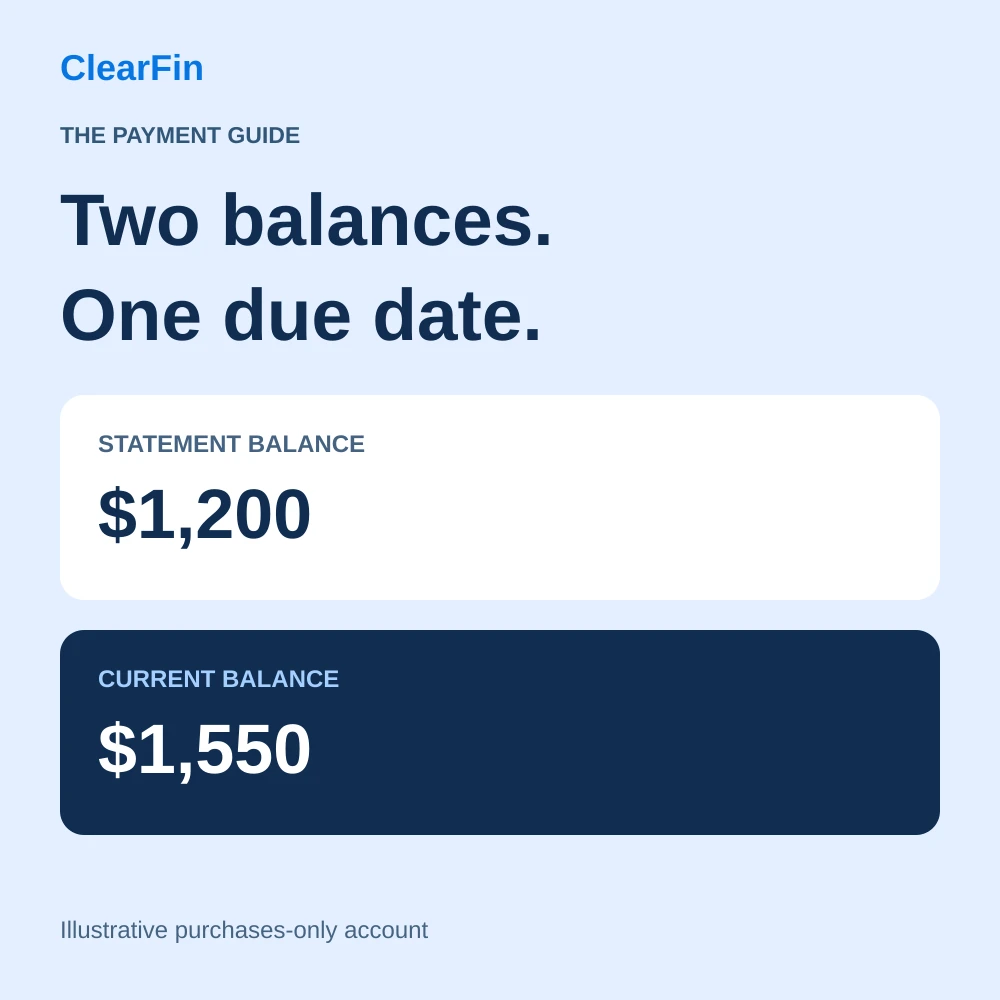
The statement balance is a snapshot at the end of a billing cycle. The current balance changes as activity reaches your account. The minimum payment is a separate, smaller obligation; paying it does not mean you have avoided interest.
This guide uses a simple account with no carried debt, instalment plans, cash advances, transfers or fees. Those situations need the payment instructions on your own statement. Sources checked November 18, 2026.
Three Numbers, Three Different Jobs
| Number | What it tells you | How to use it |
|---|---|---|
| Statement balance | What you owed when the billing cycle closed | Start here when checking the payment due for that cycle |
| Current balance | Your changing account balance after subsequent activity | Track what you owe now; check how your issuer treats pending items |
| Minimum payment | The minimum required payment for the month | Meet this deadline even if you cannot afford the full payment |
RBC explains the distinction: a statement is fixed for its billing period, while the current balance changes during the next one. An old statement PDF will not rewrite itself when you make a payment.
A $1,200 Statement and a $1,550 Current Balance
Imagine this purchases-only account, with the previous bill paid in full:
| Date | Activity | Current balance after posting |
|---|---|---|
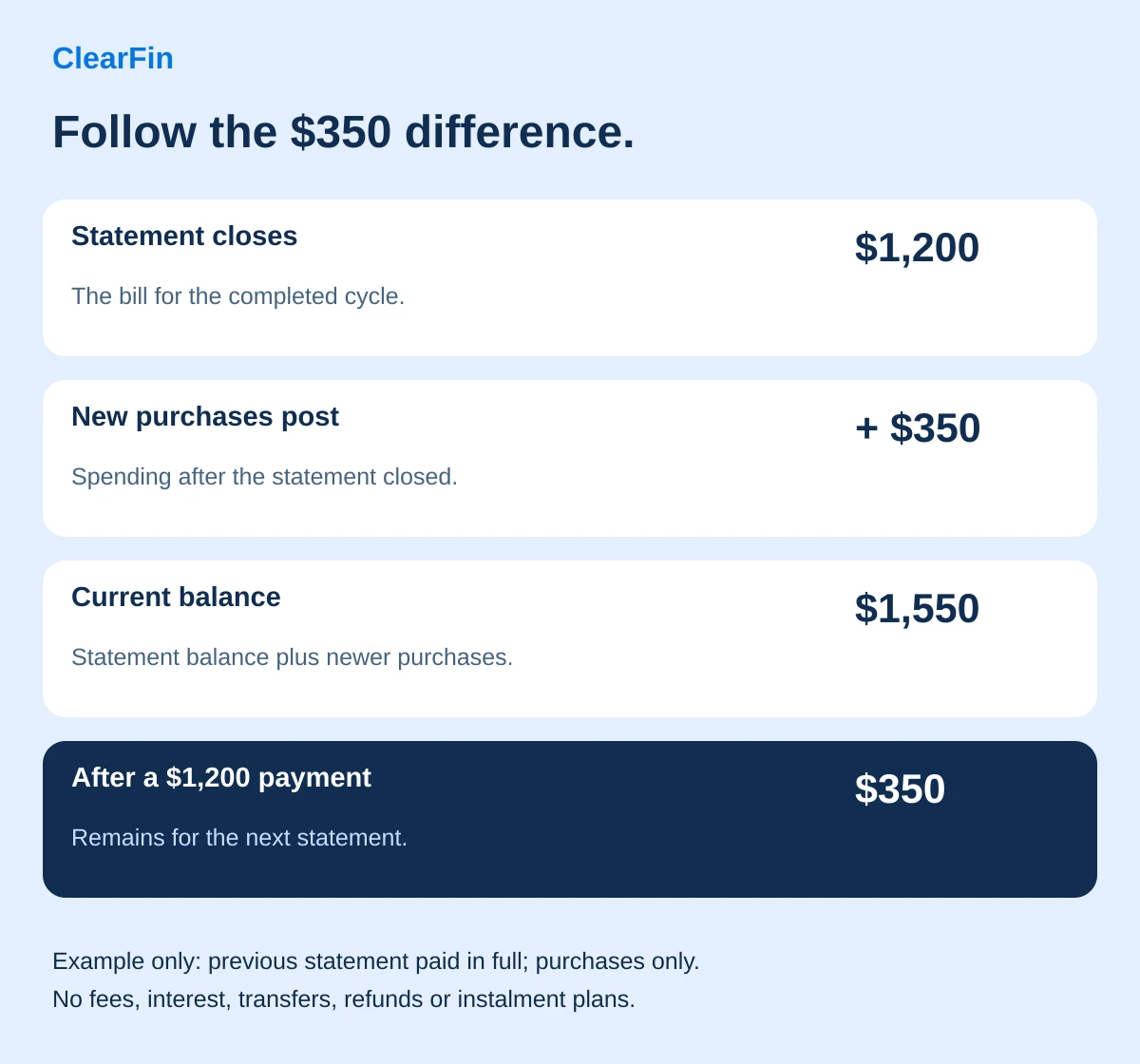
| November 1 | Statement closes at $1,200; payment due November 23 | $1,200 |
| November 5 | New grocery purchases of $250 | $1,450 |
| November 9 | New purchases of $100 | $1,550 |
| November 18 | You pay $1,200 and the payment posts | $350 |
In this example, the $1,200 payment satisfies the November statement. The remaining $350 belongs to the next billing cycle. Assuming no other activity, it will appear on the next statement with its own due date.
You can instead pay $1,550 to clear the posted balance at that moment. But the extra $350 is not required by November 23 merely because it appears in your app. These dates and amounts are an illustration, not a bank statement or an issuer-specific payment schedule.
What If You Already Paid Part of the Statement?
Using the same example, suppose you paid $400 after November 1. With no refunds, fees or other adjustments, another $800 completes the original $1,200 statement payment. The statement PDF can still show $1,200 even though you no longer owe all of it for that cycle.
Before sending money, look for a remaining-statement-balance or amount-due field and confirm that earlier payments have posted. Do not automatically subtract every refund from the required payment: check how your issuer applies credits and whether a minimum payment remains due.
Do Pending Transactions Count?
The label matters. CIBC’s statement guide says its current balance excludes pending transactions. A pending purchase can still reduce available credit before it posts.
Other displays work differently. Desjardins’ real-time balance includes authorized, unposted transactions and payments. That is why two banking apps can show apparently different totals for similar activity.
Check the transaction status and your issuer’s definition before treating an app balance as the amount due. A pending hotel authorization, for example, should not be assumed to be a final bill.
When the Simple Rule Needs Extra Care
Instalment plans: CIBC notes that paying its entire current balance also pays off outstanding Pace It plans and balance transfers. Its statement distinguishes amounts due from instalment balances not yet due. Read the payment box before paying a larger total than intended.
Cash advances and balance transfers: The Financial Consumer Agency of Canada explains that the purchase grace period does not cover these transactions or cash-like transactions. Federally regulated institutions provide a purchase grace period of at least 21 days, but that is not a blanket interest-free period for every balance.
A balance you have been carrying: Interest may already be accruing. Ask your issuer for the amount needed to clear the account, including any accrued interest, rather than assuming the displayed number settles every charge. Our Canadian credit card interest guide explains why borrowing costs can outweigh rewards.
A Payment Routine You Can Repeat
- Open the statement. Find the due date, minimum payment and amount required to obtain the purchase grace period. FCAC lists these statement disclosures.
- Reconcile recent payments. Confirm what has posted and what remains due. Keep the original statement total separate from newer spending.
- Allow processing time. FCAC’s payment guidance says timing depends on the institution and payment method. Check your bank’s processing window before the deadline.
- Check automatic payments. Confirm whether your setup pays the minimum or the full statement amount, when it starts, and how manual payments affect the scheduled withdrawal. Keep sufficient funds available.
If the full amount is unaffordable, make at least the required minimum on time and work toward paying more. For existing debt, our balance transfer comparison shows why transfer fees and repayment windows matter alongside the advertised rate.
Frequently Asked Questions
Should I pay the statement balance or the current balance?
For the simple purchases-only example above, complete the statement payment by its due date. Paying the current balance also clears newer posted spending, but may include amounts not yet due. Use the statement’s instructions for accounts with special plans or other balance types.
Why is my current balance lower than my statement balance?
A payment or credit may have posted after the statement closed. Check the transaction history and the remaining amount due; a lower current balance alone does not explain how every credit has been applied.
Does paying the minimum prevent interest?
No. It meets the minimum monthly payment requirement, but an unpaid balance can still attract interest. Check the amount your statement says is required for the purchase grace period.
Why does a balance remain after I paid my bill?
It may be newer purchases from the next cycle, as in the $350 example, or a payment that has not posted yet. Review dates and transaction status. If the numbers still do not reconcile, contact your issuer before the due date.
ClearFin’s examples are educational. Your statement and card agreement determine the amount due, payment allocation and applicable interest.